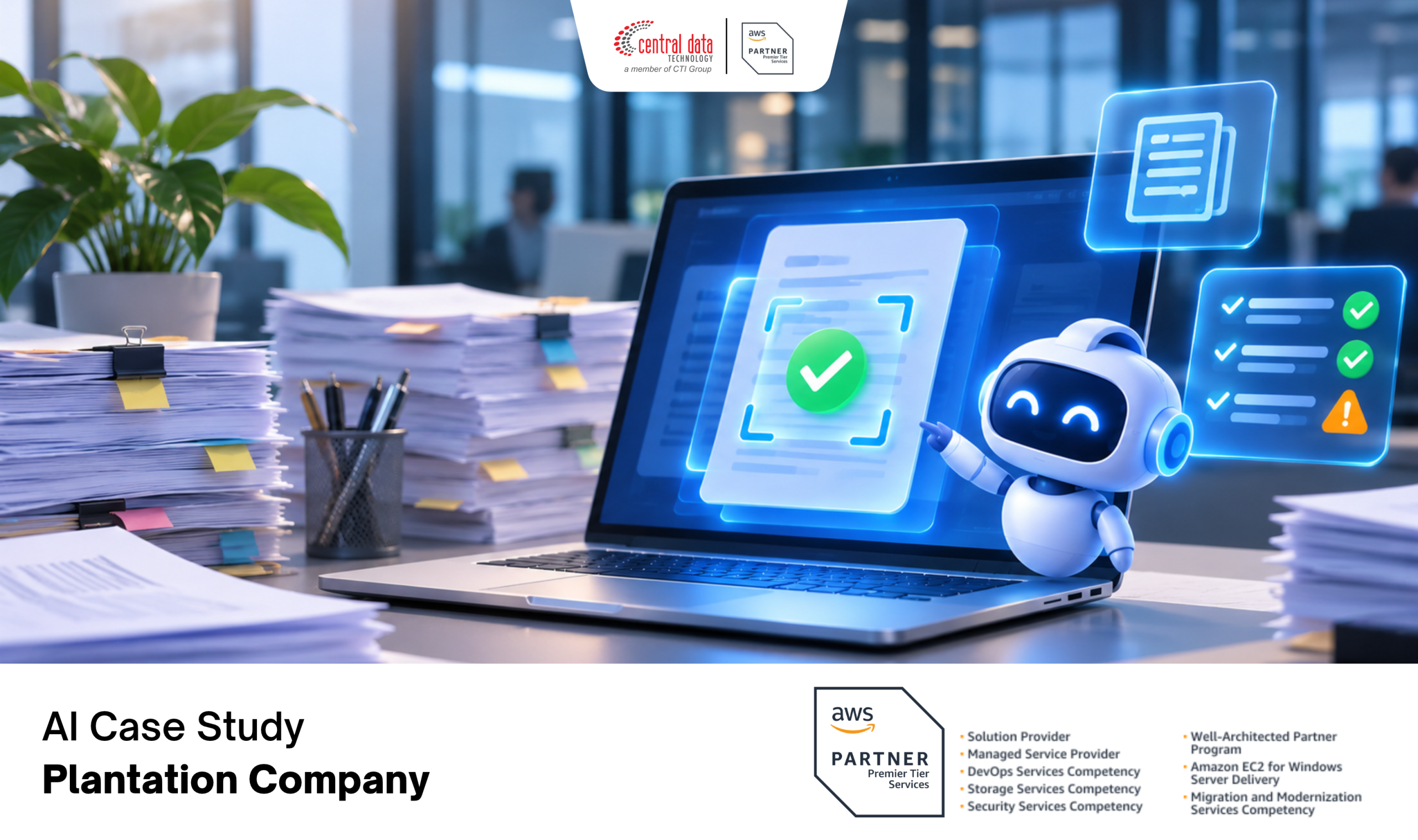
An AI-powered document validation service helps accelerate vendor reviews, identify inconsistencies, and strengthen the registration workflow.
Vendor onboarding is an important process for plantation businesses, where accurate supplier information and supporting documentation are essential to maintaining reliable master data. Before a vendor can be approved, the Master Data team must review registration forms and verify the supporting documents submitted by each vendor.
As submission volumes and documentation requirements grow, manual verification can become time-consuming and challenging to scale. To help improve this process, a large plantation company worked with Central Data Technology (CDT) to develop an AI-powered document validation solution integrated into its existing Vendor Management System (VMS), using AWS services and generative AI.
Challenges: Manual Vendor Document Checks That Were Hard to Scale
The existing vendor registration process relied heavily on manual checks by the Master Data team. Each submission required reviewers to examine the registration form and compare its information against multiple supporting documents.
Manual verification of vendor submissions presented several challenges. First, reviewing each submission manually was time-consuming and required considerable attention and effort. In addition, forms or supporting documents often contain missing or insufficient data, which made the information incomplete. Reviewers also needed to identify documents that were invalid, outdated, or no longer valid. Another issue was duplicate vendor records, as similar or repeated submissions made vendor data management more difficult. Finally, data inconsistencies occurred when the information in the registration form did not match the details stated in the supporting documents.
These challenges highlighted the need for a more consistent and scalable validation process, one that could automatically examine submitted documents while keeping the Master Data team in control of final decisions.
Solutions: AI-Powered Vendor Document Validation on AWS
CDT designed and implemented an AI-powered document validation service that works alongside the company’s existing VMS. The solution uses Amazon Bedrock with the Moonshot AI Kimi K2.5 foundation model to read and extract information from submitted documents, compare the extracted values with the registration form, and check consistency across multiple documents.
After processing a submission, the service generates validation scores, highlights discrepancies, and provides an overall recommendation to support the review process. The recommendation falls into one of three outcomes: Approve, which means the submitted information meets the defined validation requirements; Review, which means the submission contains items that require further attention from the Master Data team; and Reject, which means the submission contains issues that do not meet the defined requirements. The AI-generated recommendation is intended to assist reviewers, not replace them, and the Master Data team retains responsibility for reviewing the results and making the final vendor approval decision.
The validation service was integrated with the existing VMS, which runs on AWS Fargate. The architecture uses managed and serverless AWS services to coordinate document processing, connect the AI model, and provide operational visibility.
The solution is built on a set of AWS services, each serving a specific role. Amazon API Gateway provides the API entry point for secure communication between the VMS and the validation service, while AWS Lambda runs the receiver and processor functions that orchestrate validation, process extracted information, calculate scores, and generate recommendations. Amazon Simple Queue Service (Amazon SQS) supports asynchronous processing and decouples incoming validation requests from processing tasks. Amazon Bedrock with Moonshot AI Kimi K2.5 powers multimodal document understanding, information extraction, and consistency checks, with model inference deployed in the Jakarta Region.
For observability, Amazon CloudWatch collects logs and metrics and supports operational dashboards, monitoring, and alarms, and Amazon Simple Notification Service (Amazon SNS) delivers operational notifications and alerts. Security and governance are handled by AWS Identity and Access Management (IAM) and AWS CloudTrail, which support access control, least-privilege permissions, and auditability of relevant activities. Finally, AWS Budgets tracks solution-related cloud spending against the defined budget, and Amazon Simple Storage Service (Amazon S3) stores deployment artifacts.
Access to the service is restricted and authenticated, all traffic and queued messages are encrypted, results returned to the VMS are signed, and relevant activity is logged for audit.
Implementation Approach
CDT delivered the solution through four structured phases to ensure that the implementation aligned with the customer’s operational requirements and existing environment. In the Assess phase, CDT reviewed the existing vendor registration workflow, document requirements, AWS environment, operational pain points, project scope, and key risks. In the Design phase, the team defined the solution architecture, validation workflow, AI processing logic, security controls, and integration approach with the existing VMS.
In the Build phase, CDT provisioned the required AWS infrastructure, integrated Amazon Bedrock, developed prompts and scoring logic, automated result delivery, and connected the service to the VMS through APIs and webhooks, while also conducting functional, integration, and user acceptance testing. Finally, in the Operate phase, the solution was handed over with knowledge transfer and operational monitoring, where CloudWatch dashboards and alerts support visibility, and feedback can be used to improve prompts and validation rules over time. The validation service now runs in production as part of the company’s VMS review process.
Results: Faster Vendor Reviews with Critical Mismatches Flagged
The implementation demonstrated that AI-powered document validation can be incorporated into the existing vendor registration workflow and return a result in about 28 seconds per submission, against a target of a result within minutes. The solution passed user acceptance testing before handover. The solution is able to flag critical mismatches, including those involving tax identification (NPWP) and bank account details, and the AI validation is embedded directly into the existing VMS review process.
The solution provides reviewers with a faster and more structured way to identify missing information and inconsistencies, helping them focus their attention on submissions that need further review. Its integration into the existing VMS also allows the company to introduce AI-assisted validation without replacing the established approval process.
Manual checking of one submission, including cross-document checks, takes about 10 to 15 minutes. The AI validation returns its result in about 28 seconds, about 95% less time, so reviewers start from the flagged discrepancies instead of checking every field. At about 100 submissions per month, this frees up to about 17 to 25 hours of manual checking per month for the Master Data team.
CDT’s Generative AI Solution for More Efficient Vendor Onboarding
By combining CDT’s cloud and AI implementation capabilities with AWS services, the plantation company has taken a step toward a more consistent, scalable, and data-driven vendor onboarding process. The solution demonstrates how generative AI can support document-heavy business operations, helping teams identify issues faster while keeping people at the center of important business decisions.
Looking to streamline document-intensive workflows with AI on AWS? Contact PT Central Data Technology to explore how cloud and AI solutions can help improve operational efficiency and support your business transformation here.