The company is a well-established Indonesian Fast-Moving Consumer Goods (FMCG) manufacturer with a diverse product portfolio spanning health-oriented beverages, nutritional products, personal care, and home care. Its business operations involve product development, manufacturing, quality management, and distribution to serve consumers across domestic and international markets.
Managing these interconnected business activities requires employees across different departments to have access to accurate and up-to-date company information. From standard operating procedures and quality guidelines to HR policies, production manuals, and technical documentation, these resources play an important role in supporting daily operations. As the company’s document repository continued to grow, finding the right information efficiently became an increasingly important need. The company therefore looked for a way to make internal knowledge easier to access while maintaining control over company data and AI spending.
Challenges: Securing Internal Knowledge While Managing AI Costs
The company maintains approximately 2,500 to 5,000 internal documents, including operational procedures, HR policies, quality and safety standards, IT guides, engineering references, and finance and procurement materials. Most documents are in Bahasa Indonesia and are updated regularly. Employees previously searched the document repository and opened files individually, which made it difficult to find information quickly, especially when an answer required checking several documents.
The company also had concerns about employees using third-party generative AI services to work with internal documents, to work with internal documents. This raised questions about how sensitive company information was handled and where it was processed or stored. At the same time, licensing a per-seat enterprise AI assistant at USD 30 per user per month would amount to USD 60,000 per month for a total user base of approximately 2,000 employees. A fixed per-user fee also offered limited flexibility because employees had different levels of AI usage.
The company needed an approach that could make internal information easier to access, keep core company data within a dedicated AWS account, and provide a more flexible way to manage AI spending across different user groups.
Solutions: Implementing a Private AI Chatbot on AWS
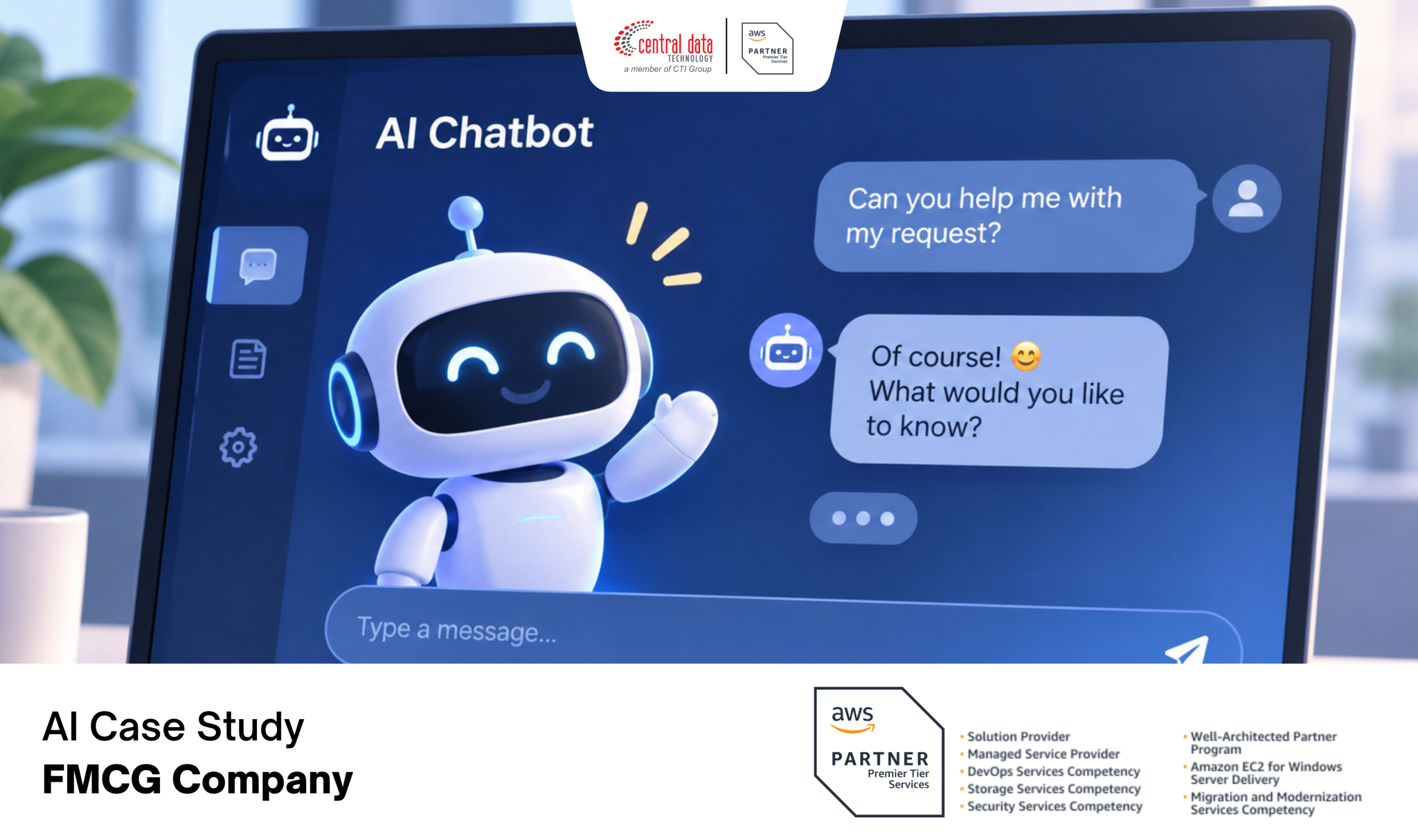
CDT proposed and implemented an enterprise AI chatbot solution, built on AWS and deployed in a dedicated AWS account. Employees access the chatbot through a web link and sign in using their existing company accounts. They can ask questions in natural language and receive answers based on approved company documents, together with references to the source material. The answers are advisory, and the original company documents remain the official reference for decisions.
The chatbot uses retrieval-augmented generation (RAG) to connect generative AI with the company’s own knowledge base. When a user submits a question, the solution retrieves relevant passages from uploaded documents and passes that context to a foundation model to generate a response. This helps employees find information across document collections without opening and reviewing each file manually.
Department document owners upload new or revised files through the chatbot interface. Apache Tika extracts text from supported document formats, while Tesseract OCR processes scanned pages. The extracted content is divided into smaller sections, converted into embeddings and indexed for semantic search. Amazon S3 stores the uploaded documents, while Amazon S3 Vectors stores the embeddings used during retrieval. Automatic synchronization with the document repository is not part of the current implementation; document owners manage uploads and updates through the chatbot interface.
Amazon Bedrock provides the foundation models used to generate answers. Cohere Embed v4 supports document embedding, and Cohere Rerank 3.5 helps reorder retrieved passages by relevance. Amazon Bedrock Guardrails checks prompts and responses against configured safety policies. Employees authenticate through the company’s existing identity provider using single sign-on (SSO), and access to knowledge collections is managed through user groups.
The solution also gives IT and Finance more control over usage costs. Rather than applying one flat license fee to every employee, the solution supports configurable monthly usage budgets for individual users or user categories. For example, the company described configurable monthly budget limits of USD 20 for CEO-level users and USD 5 for staff. These are budget limits that can be adjusted according to internal policy, not fixed charges per user.
The solution is powered by AWS services, including Amazon EC2 and a Multi-AZ Amazon RDS for PostgreSQL database for application data, chat history and usage records. Amazon S3 also stores VPC Flow Logs and AWS CloudTrail logs in separate buckets. The deployment includes an Application Load Balancer, AWS WAF and AWS Shield Standard to protect the application entry point, while Amazon GuardDuty and AWS CloudTrail support threat detection and audit logging. Amazon CloudWatch provides operational monitoring, and AWS Backup protects the database. Core data stores are maintained in the AWS Asia Pacific (Jakarta) Region. The chat and embedding models are called from the Jakarta endpoint through cross-Region inference, and reranking runs in another AWS Region because no reranking model is offered in Jakarta. Data in transit stays encrypted.
CDT delivered the implementation through four phases: Assess, Design, Build and Operate. The team first reviewed document sources, user requirements, usage patterns, security expectations and budget preferences. CDT then designed an architecture based on AWS services, provisioned the environment, configured the chatbot and AI services, and tested document ingestion, retrieval, citations, sign-in, guardrails, budget controls and user access. A pilot with 10 test users and 20 sample questions came before production, followed by technical documentation, knowledge transfer and operational monitoring for the customer’s IT team. The chatbot is now in production, powered by AWS services deployed in the Asia Pacific (Jakarta) Region.
Results: Lower AI Costs and Faster Access to Company Information
The private AI chatbot provides a more flexible cost model for an organization with approximately 2,000 potential users. Based on a full-seat licensing scenario for a per-seat enterprise AI assistant at USD 30 per user per month, the equivalent monthly license cost would be USD 60,000. The total monthly cost of the AWS-hosted chatbot, including its AWS environment and measured from the AWS billing of the account and the model spend recorded by the AI gateway, is approximately USD 2,000. This represents a difference of about USD 58,000 per month, or 96.7% lower than the full-licensing scenario, against a target of at least 50% lower. The comparison illustrates the cost difference against licensing all 2,000 users, rather than a comparison with a historical invoice for 2,000 seats.
A task that previously took about 60 minutes using the company’s internal document repository now takes about 10 minutes with the chatbot. This saves about 50 minutes per task, an 83.3% reduction against a target of at least 50%, and makes it easier for employees to locate relevant information across multiple documents.
The solution is designed for a total user base of approximately 2,000 employees, with around 300 to 500 daily active users and 80 to 150 concurrent users at peak. In pilot testing, every evaluated model answered all sample questions correctly, with source citations for in-scope questions. Because answers are streamed, the first part of each answer appeared within 5 seconds, meeting the response time target.
By building a document-based AI solution on AWS, the company gained a centralized way to access internal knowledge, manage user access and set usage budgets. The measured reduction in cross-document search time and the lower cost compared with a full-seat licensing scenario give the company a more practical foundation for expanding AI use across its workforce.
CDT Private AI Chatbot to Make Enterprise Knowledge More Accessible
CDT helps organizations build private AI solutions that connect employees with internal knowledge while maintaining control over data access, security and usage costs. To explore how a private AI chatbot could work with your organization’s documents and requirements, contact Central Data Technology here.